Pre-FOMC Tension: Will Bitcoin Repeat Its Post-Cut Pattern?

bitcoinistОпубліковано о 2025-12-11Востаннє оновлено о 2025-12-11

Анотація

Bitcoin is holding above $92,000 but sentiment remains bearish ahead of the Federal Reserve's rate decision. Historically, Bitcoin often rallies before Fed rate cuts but shows muted or negative reactions afterward, as markets price in the move in advance. A CryptoQuant report notes that past cuts, like those in September 2025, saw little immediate price movement or brief rallies followed by declines. This suggests a "buy the rumor, sell the news" pattern may occur again. Monitoring leverage, open interest, and liquidity flows is key to anticipating short-term volatility around the FOMC announcement.

Bitcoin is holding firm above the $92,000 level after rebounding from last week’s dip toward $90,000, offering bulls a brief moment of relief. Yet despite this stabilization, market sentiment remains decisively bearish, with many traders expecting further downside unless a clear shift in momentum emerges. The timing couldn’t be more crucial: the Federal Reserve’s upcoming rate decision has become the central focus for investors, and the market is bracing for heightened volatility.

According to a new CryptoQuant report, Bitcoin’s historical behavior around rate cuts offers meaningful context. Over the years, Fed interest rate cuts have generally aligned with upward movements in BTC, largely because lower rates weaken the US dollar, stimulate liquidity, and support risk assets. However, the report highlights an important nuance—the immediate reaction is rarely straightforward.

In several past instances, Bitcoin rallied ahead of rate cuts, only to show muted or even negative price action once the decision was announced, indicating that markets had already priced in the move.

This dynamic creates a layer of uncertainty heading into the FOMC meeting. While macro conditions align with long-term bullish trends for Bitcoin, the short-term outlook remains fragile, shaped by sentiment, positioning, and the market’s anticipation rather than the announcement itself.

Historical Patterns Signal Caution Ahead of the FOMC

According to the report by GugaOnChain on CryptoQuant, Bitcoin’s past reactions to Federal Reserve rate cuts offer a clear framework for understanding the risks heading into this week’s FOMC meeting. The historical data paints a picture of mixed and often counterintuitive behavior.

For example, following the 25 basis point cuts in September 2025, Bitcoin barely reacted at all. In another instance, BTC surged to a four-week high—only to drop nearly $2,000 shortly after, settling into a period of muted stability. These reactions underscore how quickly sentiment can shift once policy decisions are fully priced in.

Volatility has also played a defining role. Both the September and October rate decisions triggered brief pre-FOMC rallies, followed by notable declines once the announcements were made. After the September cut, volatility spiked sharply as traders unwound leveraged positions, revealing how sensitive Bitcoin remains to event-driven positioning.
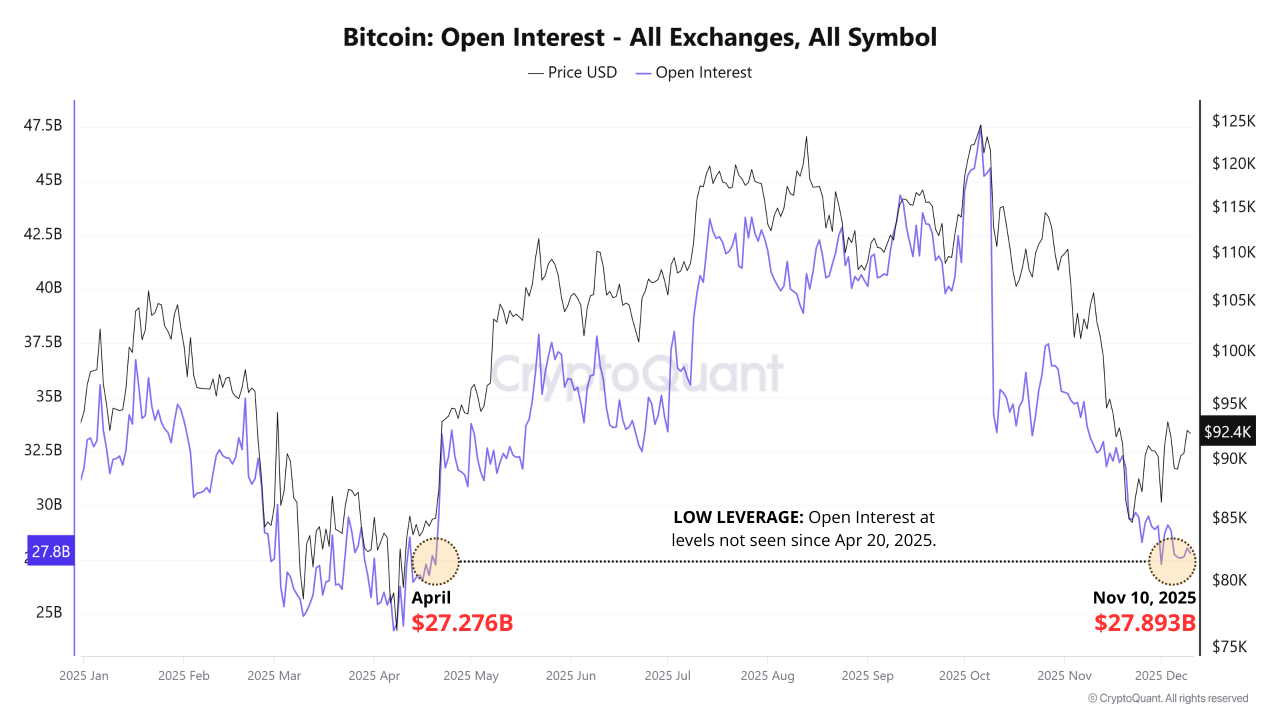
Bitcoin Open Interest | Source: CryptoQuant

This leads to the recurring “buy the rumor, sell the news” pattern, a dynamic that GugaOnChain warns could repeat. Because of this, monitoring market leverage—including funding rates and open interest—is crucial. Equally important are liquidity flows, such as exchange reserves and ETF activity. Together, these indicators help traders anticipate short-term price movements as Bitcoin prepares for another potentially volatile macro event.

Пов'язані матеріали

Eight Years of Turbulence in Web3 Phones: From 'Geek Toy' to Xiaomi's 'Factory Standard'

Web3 Smartphones: An 8-Year Evolution from 'Geek Toy' to Xiaomi's 'Standard Feature' On December 10th, high-performance blockchain Sei announced a partnership with Xiaomi, the world's third-largest smartphone manufacturer. The Sei Foundation will develop a next-gen crypto wallet and DApp discovery platform, which will be pre-installed on Xiaomi's new smartphones for global markets (excluding mainland China and the US). Utilizing MPC technology, the collaboration aims to allow users to log in directly via Google or Xiaomi accounts, eliminating intimidating seed phrases. A pilot stablecoin payment system is also slated for 2026, enabling purchases at Xiaomi's retail stores with tokens like USDC. The journey of Web3 phones began around 2018 with devices like Sirin Labs' Finney and HTC's Exodus 1, which focused on "hardware sovereignty" and extreme security, often featuring physical safeguards or trusted execution environments (TEE). These early attempts, including niche projects like Pundi X's communication-focused BOB phone and Electroneum's low-cost "cloud mining" M1, were commercially unsuccessful due to high costs and poor user experience, remaining confined to tech enthusiasts. Mainstream manufacturers like Samsung cautiously entered the space around 2019, integrating features like the Samsung Blockchain Keystore into flagship models. A notable early example was the "KlaytnPhone" edition of the Galaxy Note 10, which included free KLAY, prefiguring the later "airdrop" model. Luxury brand Vertu and HTC also made attempts, but Web3 functions often remained hidden or mere marketing gimmicks. The market was revitalized in 2023 by the Solana Saga. Initially struggling, it sold out instantly after its included BONK token airdrop exceeded the phone's price, earning it the nickname "dividend phone." This success ushered in a new era of "ecosystem binding" and token incentives. Subsequent models like Solana Chapter 2 (Seeker) refined this model with soul-bound tokens (SBT) to prevent scalping. Competition intensified with the TON ecosystem's $99 Universal Basic Smartphone (UBS), Binance Labs' Coral Phone, and the JamboPhone—a $99 device focused on "learn-to-earn" models in emerging markets. An alternative approach emerged from China Telecom and Conflux's BSIM card, which adds Web3 capabilities to any Android phone via a secure SIM card. The evolution highlights five key shifts: 1) Advanced security is moving from simple TEE to architectures like TEEPIN and MPC; 2) Phones are now gateways to specific ecosystems (e.g., Solana, Aptos, Movement Labs); 3) User growth is driven by airdrops and economic incentives, not just security; 4) The focus has shifted from technical concepts (running a full node) to practical applications like payments; 5) The scale is changing dramatically, as Xiaomi's massive annual shipments could onboard hundreds of millions of users, far surpassing niche manufacturers. The conclusion is clear: the greatest barrier to Web3 adoption is not security but complex user experience. The ultimate goal is for Web3 to become an invisible, seamless feature—like 5G—rather than a marketed label. Solana Mobile proved incentive-driven adoption works, but the partnership between Sei and Xiaomi may demonstrate that experience-driven integration is the sustainable path to bringing Web3 to a billion users.

marsbit19 хв тому

Eight Years of Turbulence in Web3 Phones: From 'Geek Toy' to Xiaomi's 'Factory Standard'

marsbit19 хв тому

Institutional Dominance in the Crypto Market: The End of Decentralization or the Dawn of a New Era?

In 2025, institutional investors now account for approximately 95% of cryptocurrency inflows, while retail participation has declined to just 5–6%, marking a structural shift in the market. According to Aishwary Gupta of Polygon Labs, this transition is driven by maturing infrastructure rather than sentiment. Major asset managers like BlackRock and Apollo are allocating portions of their portfolios to digital assets via ETFs and on-chain tokenized products, leveraging blockchain for yield generation and operational efficiency. Gupta highlights that institutional adoption is progressing in two phases: first, through yield-bearing products like tokenized treasuries and regulated staking, and second, via efficiency gains such as faster settlement and programmable assets. While retail interest waned due to meme coin losses, he expects gradual return as more transparent, regulated products emerge. Addressing concerns about centralization, Gupta argues that institutional involvement can enhance blockchain’s without compromising decentralization, provided infrastructure remains open. He envisions a future financial system where DeFi, NFTs, and traditional assets coexist on public chains. Although compliance may limit some experimentation, it fosters more sustainable innovation. Increased institutional participation is expected to reduce volatility and accelerate growth in areas like real-world asset tokenization and cross-chain interoperability. Ultimately, this trend signifies crypto’s evolution from a speculative asset to a core component of global finance.

marsbit33 хв тому

Institutional Dominance in the Crypto Market: The End of Decentralization or the Dawn of a New Era?

marsbit33 хв тому

Торгівля

Спот
Ф'ючерси
活动图片